Friday, April 1, 2011

Abortion.

Abortion is a medical procedure. It should be a matter for medical professionals, a woman and any personal advisors, religious or secular, she chooses to consult. When government criminalizes a medical procedure, you get this, which is clearly, without any question, WRONG:

http://www.aclu.org/blog/reproductive-freedom/pregnant-women-need-support-not-prison

The facts of this case are heartbreaking. On December 23, 2010, Shuai, a 34-year-old pregnant woman who was suffering from a major depressive disorder, attempted to take her own life. Friends found her in time and persuaded her to get help. Six days later, Shuai underwent cesarean surgery and delivered a premature newborn girl who, tragically, died four days later.

On March 14, 2011, Shuai was arrested, jailed, and charged with murder and attempted feticide. Had Shuai, who is being represented by National Advocates for Pregnant Women and local attorneys, not been pregnant when she attempted suicide, she would not have been charged with any crime at all.

Some discussion at Balloon Juice, wherefrom I found about it:

http://www.balloon-juice.com/2011/03/31/yes-dear-i-do-remember-when-women-were-people-too/#more-64834

No one who has either suffered major depression, nor anyone who has loved someone thus afflicted would see the state of Indiana’s actions as anything other than vicious.
Yes, that would be me, too.

I urge anyone to read the ACLU post completely. Comment here will be responded to with as much civility as I can muster, which is usually quite a lot. But you don't have to use profanity to blister paint, so if you think you can defend this, be prepared.

Wednesday, March 30, 2011

Gamestorm 2011

Mostly board games this year, and almost exclusively with Carl and Phil... Carl brought his wife, Chris, who was a very good sport all weekend. I forgot my cameras, so the photos are from my camera phone....

Friday, Phil introduced us to a game he's been playing with his daughter and her fiancee, A Touch of Evil. Pretty cards, lots of characters and opportunity for roleplay in a early 1800's horror milieu. It's not about winning and losing, it's how you play the game.....

Saturday started with a zombie game from the same company (Flying Frog Productions), The Last Night On Earth. Rather more literal and colorful game board, with some modular variation, lots of stock characters and plenty of zombies, followed with a trip to Powell's.... I should not be allowed to go to bookstores.

Saturday night was the annual Axis and Allies Anniversary Edition:

The game ended with no bragging rights and an extended recrimination phase..... Chris actually played as the US, built lots of stuff and had launched Operation Torch with substantial forces. But the Italian Navy was going to put a stop to the naval side with a side operation to take out the uncovered air power in Gibralter. The Russian front was a bloody mess with no clear winner but the Japanese had taken China and were ready to move on the Russian's naked backside and the German industrial capacity was still at a high level. The British had strength in India to argue the point with the Japanese, but my money would be on the Germans eventually burying the Russians in an avalanche of tanks and infantry backed by air power. Also, the Japanese had landed a powerful invasion force backed by carriers...in Alaska. This was bound to distract the US player from Operation Torch. See, extended recrimination phase..... ;o)

Sunday was devoted to Hordes of the Things and the drive home. Here's a pic of Phil's new Beastmen, another gorgeous army fielded by him and not done justice by the camera phone.... According to Phil this was one of those nobody-makes-a-mistake balanced-on-a-knife-edge near run things that give great satisfaction to gamers....


Meanwhile, on the next table over, Chris was winning her first Hordes of the Things battle by defeating Phil's Goblins under my command with my Orcs.... It would have been humiliating, but they were Goblins, after all, a flawed tool at best.

Sunday, March 20, 2011

Trafalgar, only more!

So, the latest War Eagles project was a continuation of our New Year's Day battle (chronicled here).

This year's scenario was a hypothetical wherein all available Spanish and French ships in the Mediterranean Sea attempt to break past a scraped up British blocking fleet in the Straits of Gibralter. The British have a large number of frigates and smaller ships, a few third rates and a couple of East India Men which the Spanish mistook for third rates and pounded to pieces....
The break out was to reinforce the Combined Spanish/French Fleet at Trafalgar. In order to create an even tougher problem for the British, Gary researched all available French and Spanish ships and inserted a Northern Reinforcement Division of seven SOL and a Frigate and the French Ghost Fleet, a well commanded, experienced, small but powerful fleet loose in the Atlantic at the time on a commerce raiding mission.

The map below was modified from a map available at Broadside, Home of Nelson's Navy...
a collection of pages describing life in Royal Navy in the late eighteenth and early nineteenth century
The original map and a description of the historical battle is here.

The scenario was designed using a similar map from "Nelson, The Commander" by Geoffrey Bennett, 1972. I believe some liberty's were taken with the order of ships in the original van, which became the rear division when the Combined Fleet reversed direction prior to the battle. I have made some adjustments to the map to allow for the actual location of our ships in our What If scenario, which begins a little later in time than the original map, as the Combined Fleet has had a bit more time to gather itself into a line of battle. By the time the British fleet approached the Combined Fleet, cohesive battle lines had been formed in both the lead and lagging divisions. The Northern Reinforcement, the Mediterranean Breakout and the Ghost Fleet all entered the table in line of battle. A number of frigates were present on both sides. They are shown on the original map, but in our re-fight, the frigates all withdrew before the battle, off table to the East and West respectively, so I removed them from the map below showing our starting positions. More or less. Unfortunately, I forgot my cameras the first day, so there are no photos. In the absence of photography, I spent a lot of time with Paint working on this map.

You can see the Africa, British 64, at the head of the Combined Fleet. Captained by Henry Digby, Africa had become separated from Nelson's column during the night. Liberally interpreting his orders to rejoin Nelson, Digby sailed down the line of battle toward Nelson's Victory at the head of the windward British column, exchanging broadsides with a number of French and Spanish ships. In our refight, he didn't quite make it to Nelson, striking his flag due to hull damage about two turns short....

As the British columns approached the Combined Fleet, all ships within range fired at the rigging of the ships at the head of the columns, Nelson's Victory and Collingwood's Royal Sovereign. Both ships were dismasted about 6 inches short of the line, disrupting the British lines of battle and ultimately preventing them from their goal of penetrating and enveloping the rear division of the Combined Fleet. The first night's action took up the first twelve turns. On our second evening's session, here is how things stood:

In the historical battle, Nelson struck the center of the Combined Fleet's line, penetrated it and initiated a general melee against the rear of the column, with a substantial advantage in numbers and quality. In the meantime, the lead division sailed on for a time and was too late in returning to the rear division which was overwhelmed. With the advantage of hindsight and reinforcements, the Combined Fleet tried a different approach. After Victory had been dismasted, the gigantic Santissima Trinidad, 130 followed by the San Justo, 74 turned to engage, paralleled by Admiral Villeneuve in the Bucentaurre, 80 followed by the Neptune, 74. With the Africa struck and a hazard to navigation immediately to windward of the Santissima, turning into the British line of battle created an unholy traffic jam. The Bucentaurre, hammered by Victory (mastless but still a gun platform) and other British ships, was forced to strike on turn 14. Neptune pulled out to pass to windward. The Santissima Trinidad, engaged by three British ships is being pounded and cannot last long. San Justo and other ships from the van are engaging the British ships pulling past the Santissima. Meanwhile, Victory has been attracting attention even though dismasted. On turn 15, after taking damage every turn, Victory finally is holed at the waterline by (FR) Redoubtable's final broadside before being forced to strike herself. Tonnant, British 84, adjacent to the east of Redoubtable, hammered by the full Northern Reinforcement line a few inches further east and pounded by Redoubtable's partner immediately ahead also struck but only after forcing Redoubtable out of the fight.

The Combined Fleet van turning immediately back into the fight plus the arrival of the Northern Reinforcement's battle line has created a substantial numerical advantage for the Spanish and French ships engaged with Nelson's column. Nelson's column is no longer a column and maneuvering is hampered by the many ships which have struck or sunk in the center and the sheer glut of ships in a small space. The Victory has struck and Nelson is transferring his flag to the Neptune, 98. It's a hard pounding for everybody and more Spanish and French ships are nearing the fight as the Mediterranean breakout and the Ghost fleet sailing upwind are nearing the leeward column.

The general situation at the end of the session:


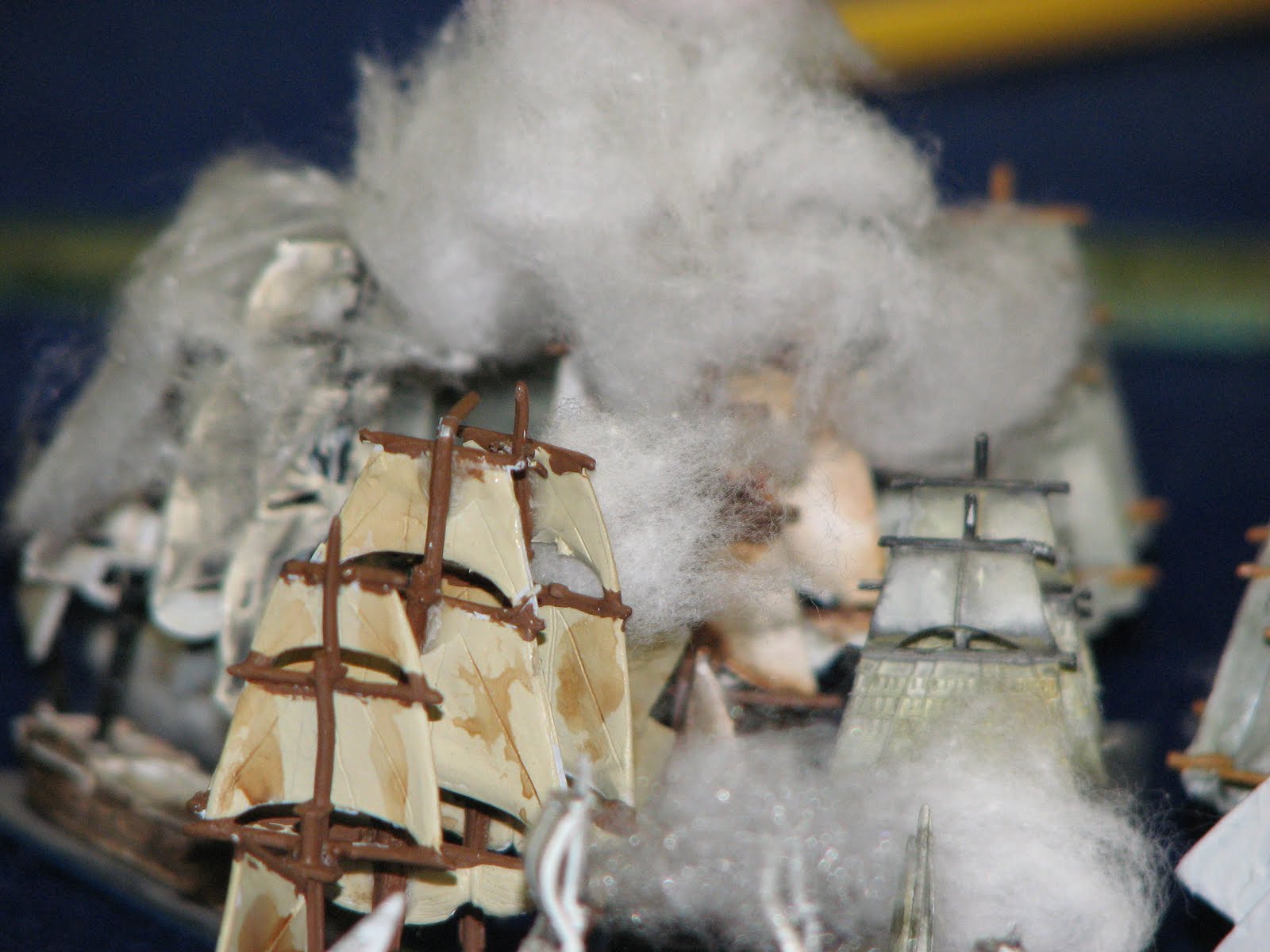
One more session was needed to reach a conclusion. But the last session would start with a huge surprise on turn 17. A picture is worth a thousand words.
Obscured by the huge cloud of smoke, throwing flaming debris and splinters everywhere, the largest ship in the world, flagship of the Spanish Fleet, the Santissima Trinidad just blew up. Good photo op. This doesn't really change the battle, she would have been forced to strike in the next turn and probably would have done very little more damage, but wow, was it unexpected. Bucentaurre (already struck), San Justo, Neptuno and Mont Blanc all took friendly damage from the explosion, but Ajax, Orion and Conqueror adjacent to the explosion, lost masts, took hull hits and lost guns.

On turn 18, Royal Soveriegn finally succumbed to the fire of the line of battle sailing past her and Collingwood transferred his flag to Belleisle. In another surprise, at the tag end of the Van's line, Intrepide, French 74 and Spartiate, British 74 coughed final defiance at each other and both surrendered. Unfortunately, neither were able to successfully fight the fires started and burned to the waterline. Behind the Spartiate, you can see where the Minotaur, hulled numerous times while sailing the length of the Combined Fleet van, has quietly sunk beneath the waves.

The Africa, Minotaur, Spartiate, Mars and Collosus (?) all managed to prove a basic principle: Sailing down a column of ships that outnumber you will spread the damage you give out over multiple ships and they will survive, while you take all the damage from the enemy ships and don't.

On turn 19, the Mediterranean breakout fleet reached engagement range, with the lead three ships all firing on what I think was Thunderer, forcing it to strike in just two turns. On turn 20, with Thunderer struck, Ajax and Conqueror unable to sail into the wind due to masts lost in the explosion of the Santissima Trinidad, the hoped for superiority of the leeward column compromised by the loss of Thunderer, Mars and Colossus, the imminent arrival of the Ghost Fleet and the head and tail of the Combined Fleet's rear division turning on it, the minor success of forcing the Argonaute to strike just didn't seem to be enough to balance the bad news. Nelson signaled for a general withdrawal.
The Lee squadron ships engaging the Mediterranean fleet at the rear of the Combined Fleet can easily sail away to the west. Belleisle and Neptune along with the two ships engaging the Northern Reinforcement, plus Orion (able to sail only down wind, but already headed that way) and Conqueror backing out of the mess can withdraw to the west. Ajax is trapped in the mess and forced to surrender.

The battle has been fought in light winds, but gale winds are expected tonight. The fleets are just a few miles off a lee shore, and ships with compromised handling are liable to be driven onto the rocks and destroyed. A common result of critical hits has been to sever the anchor cables so for many ships, anchoring in shallow water before running aground is not an option.

The final tally:

Spanish losses: The Atlas (74), San Juan de Nepomuceno (74) and San Augustino (74) all forced to strike due to hull damage and without anchors were driven onto the shore by the gale and destroyed. The Neptuno, hulled below the waterline, sank outright. And, of course, the Santissima Trinidad. All other Spanish ships were either salvaged or made port on their own.

French losses: The Intrepide (74) burned to the waterline. The Redoubtable (74) sank during the battle. The Argonaute, sailing ability compromised and anchor cable severed, was driven onto rocks and broken to splinters.

British losses: The Minotaur (74), the Colossus (74), Ajax (74) and Britannia (100) were salvaged and brought to port as prizes by the Combined Fleet. Proper allocation of the prize money remains in dispute, will remain in dispute and owing to the two countries involved, will probably have a recrimination phase lasting for centuries if the legal disputes are ever settled.... Prize crews aboard the Tonnant (80), Mars (74) and Atlas (74) were unable to keep to windward of the Cape of Trafalgar and were taken off. Peasants living near the Cape have building materials for the next 10 years. Leviathan (74), Africa (64), Thunderer (74), Royal Sovereign (110) and the Victory (100) all sank before the gale winds could wreck them.

Nelson lives, but the luster of his name has been blemished, dulled, tarred, perhaps even eclipsed. Time will tell if he can redeem himself or if the Admiralty will even ever employ him again.

UPDATE: You may have noticed in the photos above, some of (especially) the British ships are named in more than one place. I am not at all confident of where specific ships went in our scenario, and especially in the Lee Division commanded by Collingwood. Mars, Colossus and Thunderer are all over the place. If anybody can correctly identify any ships, please let me know and I will redo the photos as needed.

ALSO: I completely neglected to document the singular success of the British Reinforcing Squadron...er, ship. The ship which was observing the port from which a large portion of the Spanish Northern Reinforcement issued was released to Nelson as a reinforcement. Operating alone, **** harassed the tail of the returning Combined Fleet van, forcing two ships to strike, even while backtracking to rescue a politically important midshipman who had fallen overboard.

Monday, March 14, 2011

In case you were worried.....

Some radiation was released when the pressure vessel was vented. All radioactive isotopes from the activated steam have gone (decayed). A very small amount of Cesium was released, as well as Iodine. If you were sitting on top of the plants’ chimney when they were venting, you should probably give up smoking to return to your former life expectancy. The Cesium and Iodine isotopes were carried out to the sea and will never be seen again.
Details and bonafides here.

UPDATE: April 26

On April 13, the Fukushima Nuclear accident was upgraded to a level seven event. A level seven event is one in which radioactive material is released into the environment over a widespread geographic area. Only one prior level seven event has occurred, on 26 April, 1986, at Chernobyl in the Russian Ukraine. The Chernobyl event released aerodynamic sized particles of radioactive materials including the fuel into the atmosphere, resulting in measurable downwind fallout across wide areas of Russia, Europe and Scandinavia. The Fukushima event has not released fuel particles into the atmosphere, though it appears that there is contaminated water that will need to be controlled and some contaminated water has leaked into the ocean and water table. Radioactive Cesium and Iodine has been released into the atmosphere and into the water. Deposits seem to be confined to the immediate vicinity (within 30 kilometers) of the power plants. Leakage of material into the ocean would likely be diluted to the levels of background radiation before any serious effects could occur. The ocean is big....

Fukushima Nuclear Accident Update Log

For the period 21-25 April deposition of I-131 was detected in eight prefectures, ranging from 2.2 to 37 Bq/m2. Deposition of Cs-137 was detected in 11 prefectures, the values reported ranging from 1.3 to 69 Bq/m2. (by comparison "in the Kiev Reservoir in Ukraine, concentrations in fish were several thousand Bq/kg during the years after the accident" for example. Wikipedia)

Gamma dose rates are measured daily in all 47 prefectures. For Fukushima prefecture gamma dose rates decreased from 1.9 μSv/h on 21 April to 1.7 μSv/h on 23 April. In Ibaraki prefecture, gamma dose rates were 0.12 μSv/h. In all other prefectures, reported gamma dose rates were below 0.1 μSv/h with similar decreasing trends.

Gamma dose rates reported specifically for the eastern part of Fukushima prefecture, for distances beyond 30 km from Fukushima Dai-ichi, showed a similar general decreasing tendency, ranging from 0.1 to 19.4 μSv/h on 25 April. The latest maximum reported value for 20 April was 24 μSv/h.

The other 45 prefectures presented gamma dose rates of below 0.1 μSv/h, falling within the local natural background range.

In drinking water, I-131 or Cs-137 is detectable, but in only a few prefectures. As of 1 April, the one remaining restriction on the consumption of drinking water relating to I-131 (at a level of 100 Bq/L) applies to only one village in the Fukushima prefecture, and the restriction applies only to infants.

My conclusion is that the damage and destruction from the Fukushima nuclear accident will be measured in dollars (or yen), not in lives.... While many of the same problems encountered in the Chernobyl disaster were encountered at Fukushima, the containment vessel design used in the Fukushima plants and in US nuclear power plants, though unable to fully prevent any radioactive release has made an enormous difference in the scale of the release and its potential effects. While workers attempting to regain control of the plants have been exposed to high levels of radiation, none have even approached fatal doses and potential hazardous exposure to the general population through ground water contamination is limited to "only one village in the Fukushima prefecture, and the restriction applies only to infants" at this time.


Sunday, January 2, 2011

2011 Annual War Eagles Wooden Ships and Iron Men

War Eagles has an annual Wooden Ships and Iron Men large miniatures scenario, hosted by Gary Swearingen on New Year's Day for many years now. Previous events are chronicled here and here.


As always, photos are posted at full resolution, click to embiggen....

This year's scenario was a hypothetical wherein all available Spanish and French ships in the Mediterranean Sea attempt to break past a scraped up British blocking fleet in the Straits of Gibralter. The British have a large number of frigates and smaller ships, a few third rates and a couple of East India Men which the Spanish mistook for third rates and pounded to pieces....

The Allied forces consisted of 19 Ships of the Line including two Spanish 110's, two newly built French 74's and a variety of older third rates with 9 frigates. More or less.

Present as Commanders were Mike Farley in overall command for the British, ably assisted by Karl Soderholz and John Hayes. The Spanish were commanded by Brian Swearingen, assisted by Steve Luksic. The French Admiral was Kim Harris (that would be me), with with two new French 74's and two old frigates, a Kingdom of Two Sicilies battle line of two 74's and four frigates, and a Spanish Battle line of two old 74's and two even older 60's. Order's to the Sicilian battle line were frequently altered by the merciless moderator, Gary Swearingen.

The Allied fleet was greatly aided by a following wind that never changed throughout the game. Wind change is diced for every third turn and changes in direction and/or intensity on a 1 on a die 6 roll. The game was completed in 19 turns and 9 hours.


The Spanish fleet on the right was generally able to brush past the few frigates on the left after taking some long range rakes and some closer fire that did negligible damage. They succeeded in smashing one East Indiaman mistaken for a third rate SOL and smashed another frigate trying to retire to the upper right corner.... We'll point out these sights of interest in later photos.

There was a lot more heated action on the left as the French feinted right, back to the left and then gave up and sailed into the middle of the British block. The wiggle:


Close Action:


The lead French 74 had taken a pounding moving forward and took it into his head to get a better ship so rammed one of the British frigates and formed boarding parties. Unfortunately, every British ship in the vicinity unloaded on her and while the boarding parties survived the hail of round shot, the last of 7 hull points at the beginning of the turn was marked off in fire, just before melee. They didn't explode, but were forced to strike with 20+ blocks of boarding crew all ready to go onto the 6 crew block frigate.... Oh well, would've been a bit crowded getting away, anyway. ;o) The Merciless Moderator has made boarding actions much more difficult, requiring a full turn to organize the boarding party (and the party takes double casualties while organizing) and then requiring multiple, very deadly, melee rounds in each turn. Boarding is seldom a good idea.


Meanwhile, the Sicilian Admiral is taking a pounding.

At this point, it's pretty much a settled affair. The French 74 is lost, a stern rake from the French Admiral on the white sailed frigate forced it to strike as the Admiral moves freely around the British right accompanied by a cloud of frigates. The Sicilian's, under the Merciless Moderator's command break to their left, the British right and, making for the African coast then back into the Mediterranean. The British admiral committed one SOL to a pursuit of the badly battered Sicilian Admiral's SOL and a second SOL and four frigates. I wouldn't say it was foolhardy, they are British, but still....

Meanwhile, back in the Spanish fleet


The main Spanish fleet has cleared the British line and has clear sailing. The rejoining Spanish column will have some trouble with the two British SOLs. The third ship in the line gets trapped by the two British SOL's and takes a considerable pounding.


But the Spanish fleet exits mostly unscathed, trailed by the Spaniard who is quite soggy. The MM has ruled that it will get overhauled and taken due to its considerable hull damage, exiting the table with just one remaining hull point.


Following the Spanish, the French Admiral and his two frigates make a break for the exit.


There is always a last hurrah! Two British frigates take a stern rake on the French Admiral as he exits the table last....


This action will carry forward into a Trafalgar hypothetical, reinforced by those ships which have survived the breakout. The British have two prizes, SOL which will require SOL to haul them to port. The merchantmen are too large for the frigates to tow to port, but the British commander has indicated willingness to abandon them. There were at least two and possibly more frigates that will also have to be towed to harbor. Tow ships may be too delayed to intervene at Trafalger, at least I am hoping so, otherwise, this may turn out to be an Allied debacle. The Allies succeeded in breaking eleven ships of the line into the Atlantic, including the two Spanish 110's and a new French 74 which will are powerful fighting vessels. The British will have a shiny new French 74 to rebuild and an ancient Spanish 60 that may not be worth the bother. If the tow ships are delayed, the British will have only one SOL to add to Nelson's battle line compared to the Allies eleven. If the tow ships are not delayed (the action takes place in the Straits of Gibralter, so it will be a short tow), there could be as many as five additional British ships of the line to reinforce Nelson. Historically, there were 27 British SOL to the Allies 33 at Trafalgar. This event would make it either 44 to 28 or possibly 44 to 32. Should be interesting to find out....

Friday, November 26, 2010

Harry Potter

The first three Harry Potter books, Harry Potter and the Sorcerer's Stone, Harry Potter and the Chamber of Secrets and Harry Potter and the Prisoner of Azkaban were a delight and a sin. A delight for the fun and a sin for the enjoyment of such trivial fare. Then came Harry Potter and the Goblet of Fire. Up to the twist at the end, still a delight and a sin. But at the end of Goblet of Fire, a character we have been primed to love and admire dies, suddenly and without preparation the stories turned down a darker road. Instead of reading and then rereading with sinful delight, I read Harry Potter and the Order of the Phoenix, Harry Potter and the Half-Blood Prince and Harry Potter and the Deathly Hallows with bated breath and my heart in my throat waiting for the death of someone I had grown to care about. Then I put them aside and never went back to them, so I never grew to know the stories like I knew the first three. And I didn't get to see the characters I cared about grow into adults the way I knew them as children. So, today, I am watching the last three movies and this weekend we will go to see the Deathly Hallows, Part I.

Sunday, November 21, 2010

Desolation Con - November 20, 2010

Desolation Con 2010 has to rate as a general success. Lots of gamers had lots of fun, many playing new things. Gamemasters had new gamers and their tables were filled with joy.

Here's some pictures from the basement of the Richland Odd Fellows Lodge.

A crowdshot from the last session of the day.


Gearing up for Hordes of the Things. I ended up with eight players on four battle fields, some of them entirely new to even the notion of miniatures battles....


Best plane photo of the day....


Space: 1889 RPG "Rescue the Princess"


War Eagles presents Wooden Ships and Iron Men